The operational guide provides a practical framework for the award of Joint European Degree Label by outlining in more detail both the procedure for awarding the label and the criteria that joint programmes need to meet.
Joint European Degree Label evaluation and award procedure
This section provides information on the practicalities of how the label is awarded and how it can be received by joint programmes leading to joint degrees. It represents the The core source of this information is the Operational Guide for the Joint European Degree Label.
Eligibility
In order to be eligible to receive a Joint European Degree Label, the joint programmes has to:
- Be offered by a consortium that includes at least two degree-awarding higher education institutions from at least two EU Member States
- Lead to a joint degree award
- Correspond to a nationally recognised degree type at EQF levels 6, 7 or 8 (Bachelor, Master, Doctorate)
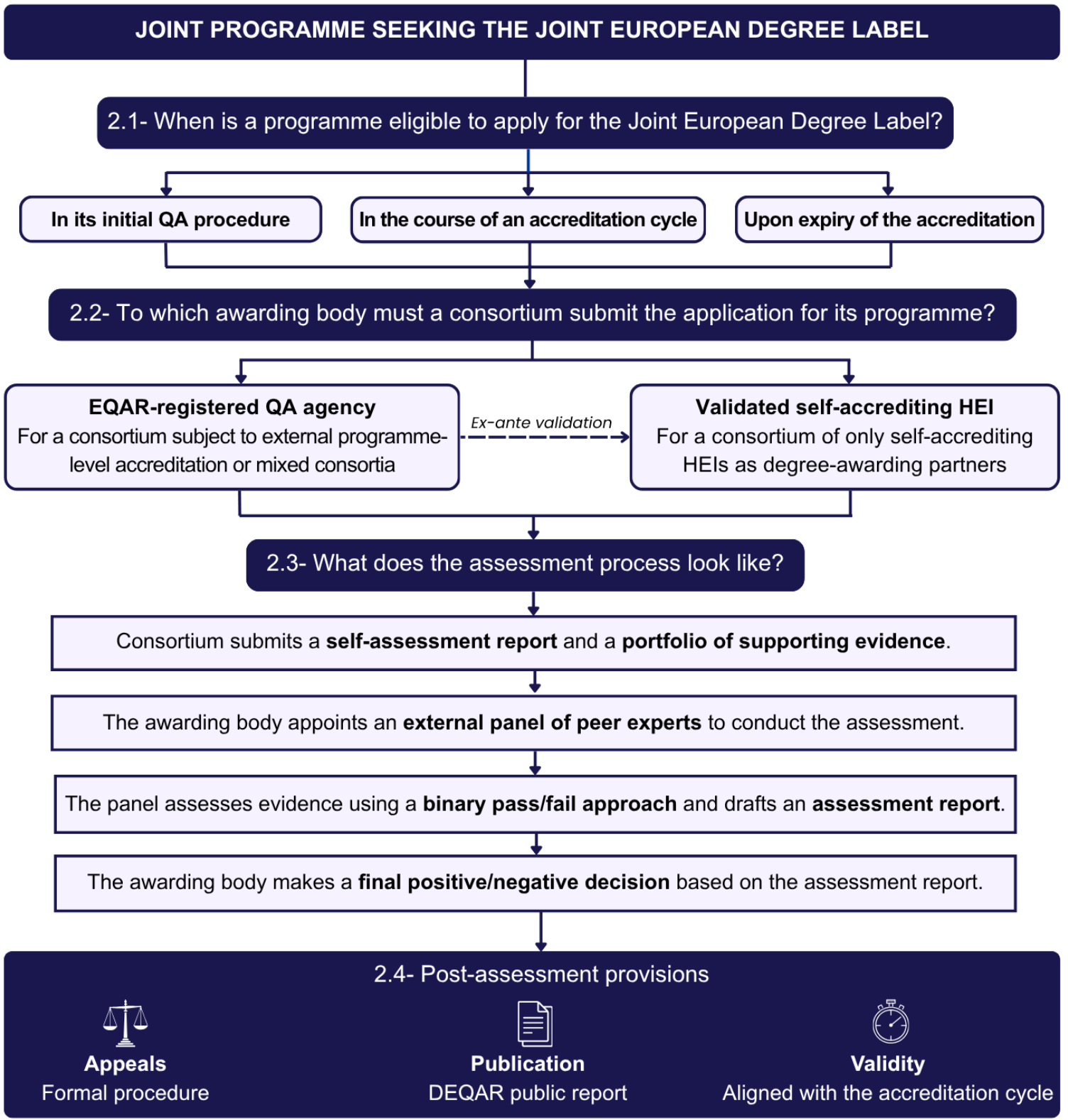
Joint programmes can conduct the evaluation for the purpose of Joint European Degree Label being awarded in one of three ways:
- For programmes that are only starting: through an integrated evaluation with initial external accreditation of a new joint programme using the European Approach procedure and a compliance assessment against the criteria of the Joint European Degree Label. The label can be awarded if both the evaluation and the compliance assessment yield positive results.
- For running programmes and those that are only starting: through a standalone assessment against the criteria of the Joint European Degree Label during the accreditation cycle of a joint programme. The consortium must demonstrate that the joint programme was positively evaluated against the standards of the European Approach and complies with the criteria of the Joint European Degree Label.
- For running programmes: upon expiry of the accreditation period, if applicable, in one integrated evaluation combining a re-evaluation using the European Approach procedure and a compliance assessment against the criteria of the Joint European Degree Label.
Awarding bodies
There are two options for an entity which awards the Joint European Degree Label:
- EQAR-registered QA agencies based in EU or EEA EFTA states.
- Consortia composed exclusively of self-accrediting higher education institutions (i.e. those that are not subject to mandatory programme-level external QA and have the right to deliver programme and award degrees without external approval).
Application and initital steps
A) QA agency as an awarding body
Consortium delivering the joint programme can apply to any of the EQAR-registered QA agencies based in EU or EEA EFTA states, and the list of QA agencies currently conducting such evaluations is available here: List of awarding agencies.
The consortium should provide the agency with relevant initial input, including a completed self-assessment report and a portfolio of supporting evidence (relevant templates are provided in the annexes of the Operational Guide).
B) Self-accrediting higher education institutions as awarding bodies
Consortia composed exclusively of self-accrediting higher education institutions can either choose a QA agency which will evaluate their joint programme against the Joint European Degree Label criteria or they can designate one of the institutions within the consortium to serve as the evaluating and awarding body. In this scenario, the awarding institution needs to undergo an external ex-ante validation by an eligible QA agency to ensure that the institution can assess the compliance with the criteria for the Joint European Degree Label in line with the Operational Guide.
Consortium is expected to provide equivalent type of initial input to the awarding institution, including a completed self-assessment report and a portfolio of supporting evidence (relevant templates are provided in the annexes of the Operational Guide).
Evaluation and award of the label
Evaluation of joint programmes against the Joint European Degree Label criteria is conducted by an external review panel. In cases when this evaluation is conducted in combination with the European Approach external review, the same panel conducts both evaluations. In cases when the Joint European Degree Label evaluation is conducted as stand-alone, in alignment with the requirements of the ESG, the panel consists of at least three international peer experts, including one student member of the panel.
The consortium provides the panel with all relevant evidence in addition to the evidence provided within the initial submission and application. In line with the Operational Guide, this may include (but is not limited to):
- Consortium agreements
- External review reports
- Internal QA documentation
- Evidence drawn from consortium-level frameworks where applicable;
- Input from relevant stakeholders such as: designated programme representatives, coordinators, academic staff, students or others
- Information gathered during a site visit, as appropriate.
The evaluation panel assesses all the relevant evidence and determines whether the joint programme under evaluation meets all the Joint European Degree Label criteria. The evaluation is based on a binary approach: each criterion is deemed to be either met or not met. Following the evaluation report by the panel, the awarding body has three options:
- If all the criteria are met, to award the label.
- If some criteria are not met, not to award the label.
- If shortcomings are identified, to ask for clarifications and/or additional evidence, or to ask the consortium to implement the suggestions of the panel and correct the application within a set period of time.
Post-award provisions
In case of a positive evaluation leading to the award of the label, the validity of the awarded Joint European Degree Label is aligned with the accreditation cycle of the joint programme. The label is valid until the accreditation of the joint programme expires or a new QA evaluation is required. Consortium delivering the joint programme which received the label is obliged to follow the usage rights as prescribed by section 2.4.4 of the Operational Guide.
In case of a negative evaluation leading to a refusal to award the label, the joint programme consortium may not submit a new application for the same joint programme within one year of the final decision. The applicant consortium has the right to submit an appeal or a complaint for both procedural issues and the award decision.
Regardless of the nature of the final decision, the evaluation report needs to be published in DEQAR and relevant national authorities should be informed.
In exceptional circumstances, the awarded Joint European Degree Label may be withdrawn if substantiated evidence indicates that the joint programme no longer complies
with the label criteria. The QA agency that awarded the label, or, in the case of labels awarded by self-accrediting HEIs, the QA agency that carried out the ex-ante external validation may withdraw the label, in line with the procedure prescribed in more detail by section 2.4.3 of the Operational Guide.
Frequently asked questions (FAQ)
to be developed