Managing the Register
EHEA Key Commitment
In 2025, higher education institutions in 33 of the 47 EHEA member countries (or 36 of 51 higher education systems, if counting Belgian and UK systems) were subject to regular external quality assurance in line with the ESG, carried out by EQAR-registered agencies.
In 2026, the Register Committee is expected to consider three initial applications for registration from two other EHEA countries.
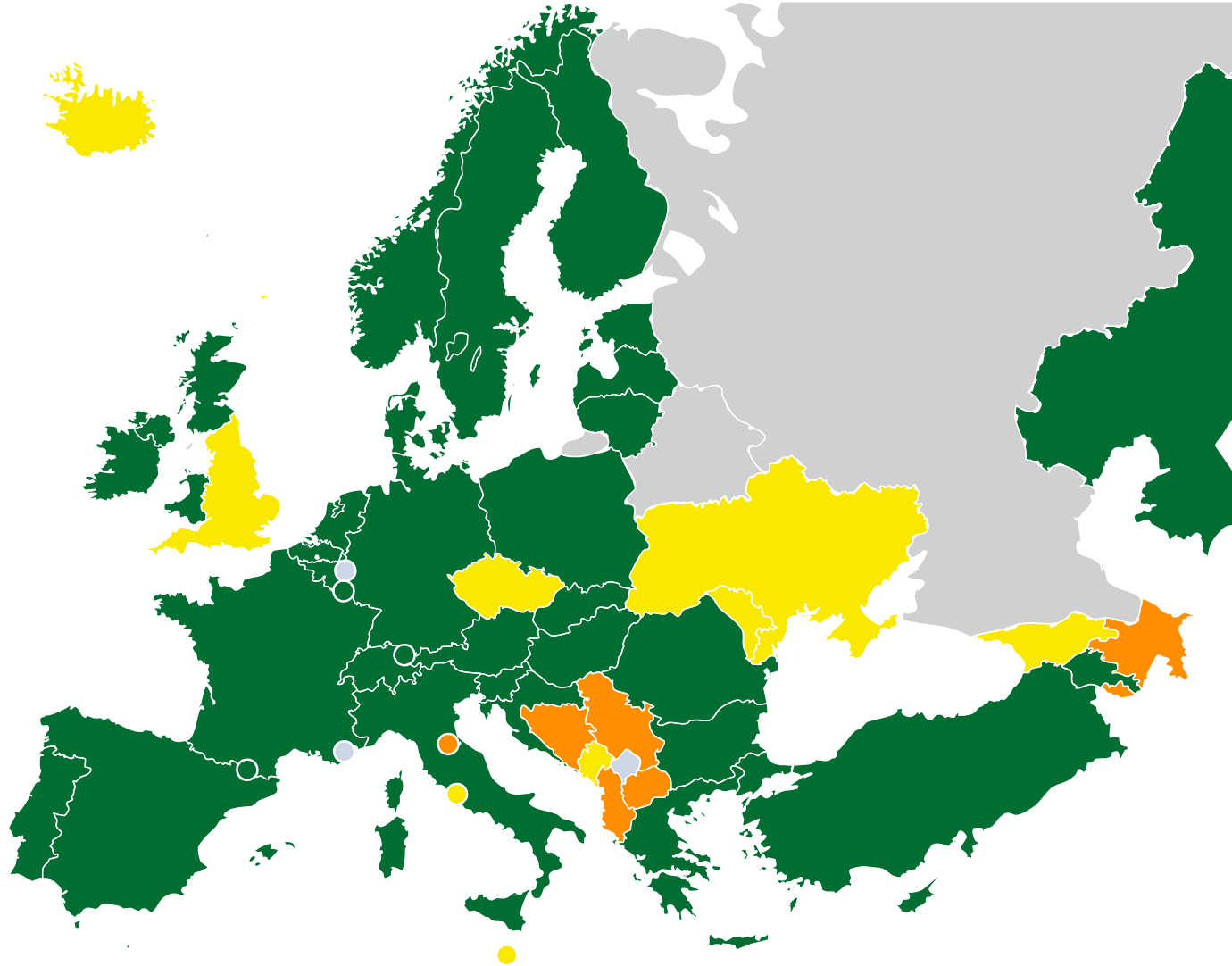
Map Legend
Green: A fully functioning quality assurance system is in operation nationwide, in which all higher education institutions are subject to regular external quality assurance by an agency that has successfully demonstrated compliance with the Standards and Guidelines for Quality Assurance in the EHEA (ESG) through registration on EQAR
Yellow: A fully functioning quality assurance system is in operation nationwide but only some higher education institutions are subject to regular external quality assurance by an agency that has successfully demonstrated compliance with the ESG through registration on EQAR
Orange: A quality assurance system is in operation nationwide, but has not (yet) been fully aligned to the ESG
Red: No quality assurance system is in operation
Decisions on Inclusion and Renewal of Registration
At the end of the 2025, 60 quality assurance agencies were listed on the Register (*).
During the year, the Committee took decisions on nine applications, all of which were approved. Out of the nine decisions, six related to renewals of registration, while three agencies were newly admitted* to the register. A list of all decisions taken in 2025 and previous years can be accessed here, while the table below provides an overview:
|
Decisions Applications |
||
| Approved |
Rejected |
|
| Initial registration | 3 | 0 |
| Renewal of registration | 6 | 0 |
| Appeals | 0 | 1 |
(*) When an agency with an initial application is accepted to the Register, the “listed since” date on the Register is the date of publication of the external review report (rounded off to the first day of the month concerned), which can be in a different (previous) year than when RC decision was taken. Additionally, if the agency goes through the focused review, and the re-application is successful the agency shall be included for five years from the date of the first, full external review report. That is why two agencies that were newly admitted to the Register in 2025, have a registration date in 2024.
In 2025, the Register Committee took four decisions on applications based on targeted reviews, which allows agencies whose registration has been renewed at least twice, to undergo a more focused external review. More information about targeted reviews can be found here.
Applications for registration received in 2025
In 2025, EQAR received 13 applications for registration. The first step of the application process is reviewing the eligibility. Out of these applications, one application, received at the very end of 2025, was processed in 2026. Remaining 12 applications were processed in 2025 and were found to be eligible for registration on EQAR. Further details and observations are provided below:
- Four of the applications submitted to EQAR in 2025 were for initial inclusion on the register.
- One of these applications was submitted by an agency that is undergoing a focused review (i.e. a follow up review after rejection on renewal of registration in 2024).
- The rest of the applications (eight in total), were submitted by agencies whose registration was expiring in 2026. Five of these agencies decided to undergo a targeted rather than a full review. Decisions on these applications for renewal of registration are to be taken throughout 2026.
The table below presents further details on the applications.
|
Applications |
||
| Initial registration |
4 |
0 |
| Renewal of registration |
8 |
0 |
| Focused review | 1 |
0 |
|
Status |
||
| Waiting for a report |
12 |
|
| Currently being considered |
1 |
|
| Completed |
0 |
|
| Withdrawn |
0 |
|

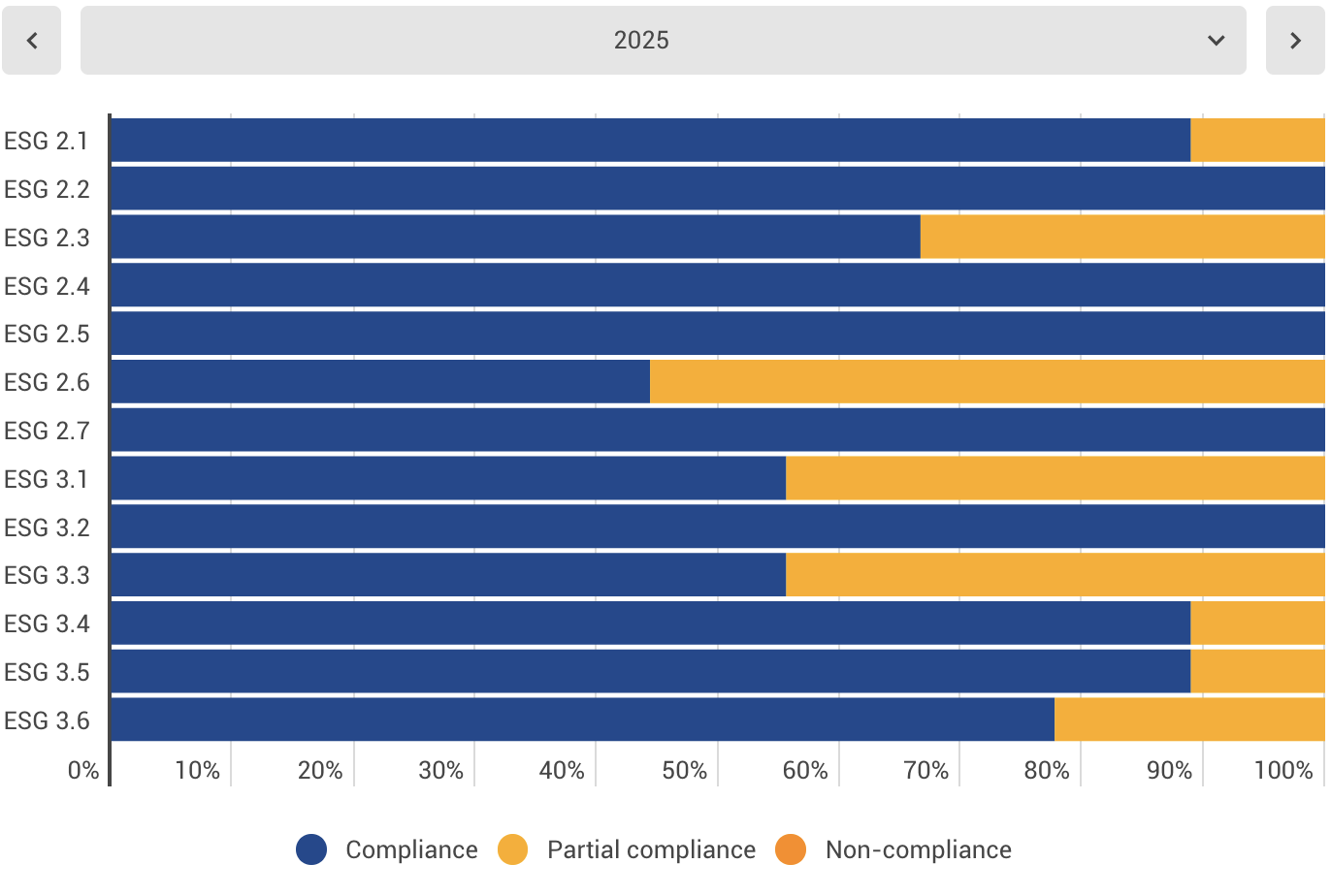
Applicants’ level of ESG compliance
On our webpage “Analysis of Decisions” we have various interactive charts/maps on applications and ESG compliance, as well as some other statistics on the application process and Register Committee decision-making, among which a fully interactive chart illustrating the ESG compliance level achieved by applicant agencies (successful and unsuccessful), broken down by various dimensions.
Monitoring of Registered Agencies
All registered agencies are expected to notify EQAR about changes to their legal form and status, amendments to their statutes and substantial changes in their process or methodology that may affect the agency’s substantial compliance with the ESG.More details on reporting substantive changes can be found here.
With 20 substantive change reports considered in 2025, this number remained constant (or similar) to the ones in 2024 and 2023 (i.e. 20 and 21 substantive change reports respectively). Comparatively, this is higher than the 13 reports in 2022 and the 16 reports in 2021.
Since the Register Committee did not have major concerns over the impact of reported changes on compliance of the registered agencies with the ESG, the Committee decided to merely take note of the changes in all the cases submitted in 2025.
Looking at the types of changes reported by agencies, a significant number of reports included changes in the agency’s external quality assurance activities, from introducing changes in existing activities (25%) to initiating new activities (40%). Additionally, 35% of reports listed changes in external QA outside the scope of the ESG, mostly by adding new activities to their portfolios. These changes illustrate that many agencies have adapted or expanded their range of external quality assurance activities. In nearly half of the of cases, the agencies also reported changes in their organisational structure and identity (45%) (see chart).
In some cases the agencies changed their structure and/or their governance (QAA, MAB, AAQ, AI, PKA, ASHE). In other cases, these changes came as a result of agencies widening their offer of external QA activities to diversify the portfolio and to further contribute to the development of the system(s) they operate in (QAA, ACPUA, ACCUEE, MAB, AVAP, ANECA, AEQES, BAC, FIBAA, PKA, ASIIN, IQAA, ASHE).
The table below summarises the types of changes reported by registered agencies.

Targeted reviews
Targeted reviews are an approach co-created together with ENQA in 2021, aiming to reduce “review fatigue” for those agencies that have already successfully completed two reviews against the ESG. During the targeted review process, the review focuses on ESG standards that were partially compliant during the last review and/or ESG standards possibly affected by recent changes. Each targeted review also addresses standard 2.1 and at least one other standard, chosen by the agency as an enhancement area.
⇒ Read more about targeted reviews
⇒ Download the Policy on Targeted Reviews
In 2025, there were four QA agencies that completed their targeted reviews, which were then considered and approved by the EQAR Register Committee (see resulting reports for MusiQuE, BAC, ACSUCYL and madri+d). For the completed procedures, the Register Committee followed the panels’ conclusions (on ESG standards) in 31 cases and did not follow the panels’ conclusions in four cases only. In 2025, the Register Committee also confirmed the terms of reference for four QA agencies who applied for this procedure
Liaising with review coordinators
EQAR has continued its close collaboration with ENQA as the coordinator of the majority of reviews for EQAR registration. All eligibility confirmations that the EQAR Register Committee issued in 2025 were for processes coordinated by ENQA. EQAR and ENQA staff have continued the practice of holding (bi)monthly (online) coordination meetings on current reviews and applications. These regular meetings have helped to facilitate a smooth and prompt exchange of information.
Revised Policy on the Use & Interpretations of the ESG
Following the consultation on the Policy on the Use and Interpretation of the ESG (U&I), launched in 2024, the revised version of the document was published in 2025. The Register Committee took into account comments and suggestions that were provided by review agencies, review panel members, review coordinators and former RC members.
The Policy assists applicant QA agencies, review panels and the Register Committee itself when interpreting the Standards and Guidelines for Quality Assurance in the European Higher Education Area (ESG). The document supports a common understanding, without being exhaustive or exclusive, simply aiming to increase transparency, awareness and consistency within the decision-making process of the Register Committee.
The first version of the document came to light in 2013, followed by a second and third version in 2015 and 2020. The latter took into account the new practices and approaches in external quality assurance (including those developed as a response to the COVID-19 pandemic and also the developments in higher education).
Having gained new insights from considering more than 50 new applications since the 2020 revision, the Register Committee proposed a set of revisions to the U&I to reflect the precedents in its decision-making. To further promote and elaborate on the policy, EQAR organised a webinar at the end of February. Around 120 people joined the webinar during which the revisions were clarified per standard and participants were given ample time for questions.
⇒ Download the revised Policy on the Use and Interpretation of the ESG
Policy on the transition to the revised ESG in 2027
As the work on the ESG revision progressed in 2025, EQAR developed a policy for the transition period towards the new ESG in 2027. Since this revision will impact the process of quality assurance agencies’ registration process in EQAR, there was a clear need to develop such provisions.
The Policy on Transition to the Revised ESG 2027 outlines the framework to be applied with agencies’ applications immediately before and after the revision, with the aim of allowing agencies to plan ahead and enable a swift transition to the revised ESG. The Policy intends to ensure that the applicants for EQAR registration have sufficient time to adjust their structures or processes, while at the same time guaranteeing that all agencies on the Register will have been admitted or their registration renewed based on the revised ESG at the latest by 2033.
Revision of the Procedures for Applications
During the summer of 2025, the Register Committee conducted internal and member-wide consultations to revise EQAR’s Procedures for Applications—the binding regulations on the application process.
Following these discussions and in accordance with the EQAR Statutes, the Register Committee formally adopted the revised Procedures during its November meeting. The updated document includes several key changes:
- Deadlines: clearer timelines for submitting applications and external review reports
- Additional Representations: defined deadlines for providing additional representation
- Focused Reviews: clarification on the scope of focused reviews, clarification on the timeline for completion of focused reviews and eligibility criteria for applicants
- Re-application: explicit timelines for agencies that want to re-apply after a rejection decision for initial registration