Contributing to the Development of the EHEA
ESG Revison
Based on the mandate given by the Tirana Ministerial Communiqué of May 2024, the process of revision of the Standards and Guidelines for Quality Assurance in the European Higher Education Area (ESG) started in September 2024. The revision process is coordinated by the Steering Committee, composed of representatives of seven organisations active in the field of higher education: EQAR, European Association for Quality Assurance in Higher Education (ENQA), European Students’ Union (ESU), European University Association (EUA), European Association of Institutions in Higher Education (EURASHE), BUSINESSEUROPE, and Education International.
So far, the Steering Committee has held eight meetings, out which six were held in 2025. As part of the ongoing work on the revision, two BFUG consultations were organised: in February and December. In November 2025, the Steering Committee finalised the first draft of the revised ESG and initiated the public consultation on the draft.
The process is expected to be completed in the spring of 2027, when the draft of the revised ESG will be presented to EHEA Ministers for adoption at the Ministerial Conference.
Contribution to the EHEA Work Plan and projects
EQAR contributes to the European Higher Education Area (EHEA) working structures as well as to other relevant European policy developments following closely its plan of work.
In 2025, EQAR supported the implementation of EHEA reforms in the meetings of the Bologna Follow-up Group and its working structures (Thematic Peer Group on QA, Thematic Peer Group on Recognition, Working Group 1 on Monitoring the Implementation, Task Force on the Long-Term EHEA Secretariat).
- As part of the BFUG Monitoring Working Group (WG1), EQAR contributed to the discussion on the indicators for the Bologna Process Implementation Report, and contributed to planning of EQAR data feeding into the report.
- In the meetings of the Thematic Peer Group on Quality Assurance (TPG C), EQAR contributed to the discussions on aligning legal frameworks with the ESG, cross-border QA, facilitating the implementation of the European Approach, and enhancing the information provision from EQAR.
- In the meetings of the Thematic Peer Group on Recognition (TPG B) EQAR emphasised the importance of links between QA and recognition, and supported the discussions on digitalisation of recognition processes and the implementation of LRC principles.
- Within the Task Force for the Long-Term EHEA Secretariat, EQAR contributed through its experience as the only legal entity established within the EHEA framework.
Through its involvement in various projects (see also Projects below) and events, EQAR fed its expertise into relevant discussions and initiatives related to quality assurance (e.g. the ECTS Users’ Guide revision, European degree label initiative, European Higher Education Interoperability Framework, the European Higher Education Sector Observatory), amongst others through the EEA Higher Education Working Group, the ECTS Users’ Guide Advisory Group, the EHESO Advisory Board and the QualityLink platform.
In 2025, EQAR continued to monitor developments in external QA at system level across the EHEA and to maintain the Knowledge Base of national/regional frameworks for external quality assurance. EQAR also initiated the planning on upgrading the Knowledge base through the SIQA project (⇒ more about the SIQA project).
Openness to cross-border external QA with an EQAR-registered agency
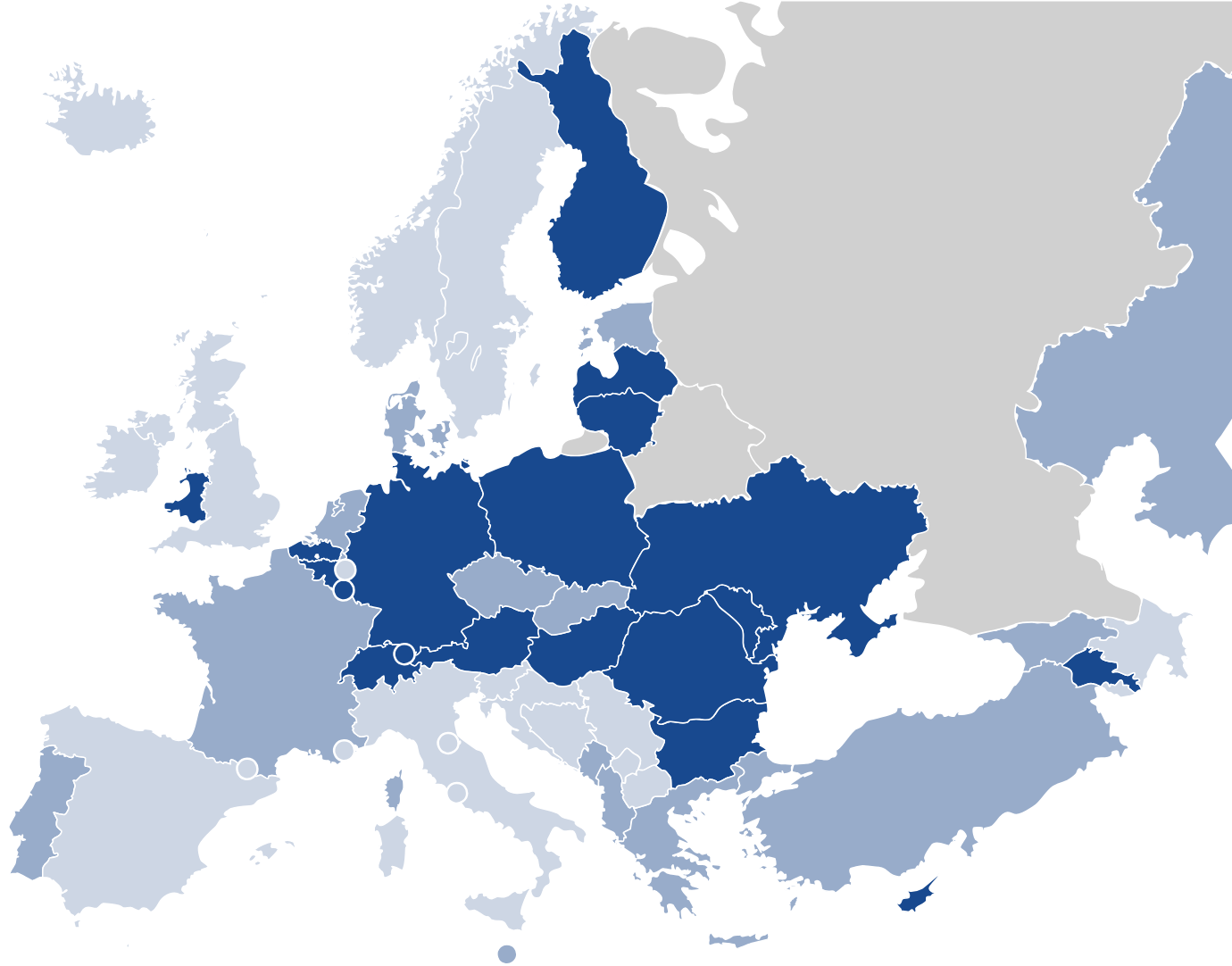
In 2025, higher education institutions in 19 higher education systems in EHEA (shown as dark blue on the map just below the chart) were eligible for cross-border QA with officially recognised outcomes, while 14 other (shown as medium dark blue) allow recognition of procedures with EQAR-registered agencies under certain conditions. DEQAR data also shows that after a slight decline in 2024, there is again a slight relative increase in the number of CBQA external QA results uploaded to DEQAR: from 3.3% of all reports in 2024 to 3.7% in 2025, indicating that the numbers are mainly remaining stable over the years. In order to support and facilitate the best practices of CBQA, EQAR has also joined the Working Group on CBQA formed under the SIQA project, which will update the document of Key Considerations for CBQA, and develop a Code of Conduct for CBQA.
Despite the slow pace of development in legal frameworks on the openness to cross-border QA, EQAR has seen that there is willingness from some countries to work towards opening their systems to cross-border QA in the coming years.
More information on the cross-border external QA activities of EQAR-registered agencies can be consulted on our website here.
Use of the European Approach for Quality Assurance of Joint Programmes
In 2025, the European Approach for Quality Assurance of Joint Programmes (EA) was available to higher education institutions in 24 higher education systems (map: dark blue), with three new systems (Italy, Slovakia and Ukraine) revising their legislation in 2025 in order to enable their institutions to use it. In six of those systems the European Approach is available by virtue of external quality assurance being required at institutional level only.
In 13 EHEA systems, the European Approach was only available to some higher education institutions or subject to specific, additional conditions (map: light blue). The map below gives an overview, the information on each country provides further details, such as an explanation of a specific legislation or the fact that higher education institutions themselves are responsible for the quality assurance of their programmes. In 15 EHEA systems, higher education institutions remain unable to use the European Approach as of 2025, creating an additional burden for those institutions when engaging in international cooperation.

EQAR has maintained a specific page on its website with a list of example cases where the European Approach was used, to allow others to draw from these experiences. Until the end of 2025, 80 external quality assurance procedures had been completed in line with the European Approach based on information available in DEQAR. This is 11 reports more than by the end of 2024, (69 reports). These procedures cover 34 EHEA systems (see map below).
| Agency | Number of reports |
|---|---|
| ACCUA | 4 |
| ACSUCYL | 2 |
| AQ Austria | 3 |
| AQAS | 19 |
| AQU | 11 |
| ASHE | 1 |
| HCERES | 4 |
| NVAO | 27 |
| QQI | 1 |
| Unibasq | 4 |
| VLUHR QA | 2 |
| ZEvA | 3 |
NB: For practical reasons, EQAR is unable to keep track of European Approach reviews that have not been added to DEQAR. Some institutions have contacted EQAR regarding their European Approach accreditation not showing up in the list. EQAR has encouraged the respective agency to upload those reports manually, even if they are unable to upload their other external QA reports to DEQAR at this stage.
The numbers mentioned above also exclude any institutions that might have used the European Approach in their internal QA arrangements, e.g. in cases where no external programme accreditation/review is required, as there is no reporting on such cases.
On the map above you will find programme accreditation/evaluations in line with the European Approach (based on reports uploaded to DEQAR; each pin represents a higher education institution part of a consortium offering a joint programme; each programme is represented by a distinct colour).
⇒ Check out the links below, regarding the European Approach for QA of Joint Programmes:
-
European Approach
In 2025, EQAR was awarded funding for three new projects, in which EQAR contributes as a project partner:
SIQA project
The SIQA project “Support for the enhancement-oriented implementation of the quality assurance key commitment” is a three-year project that started in September, coordinated by ARACIS.
SIQA will support the work of the Bologna Thematic Peer Group C on Quality Assurance (TPG C on QA) during 2025-2028, building on the achievements and best practices from the IMINQA project that supported the work of the TPG C during 2022-2025.
- Enhancing the EQAR Knowledge Base
One of the project objectives important for EQAR, is to update, enhance and expand the EQAR Knowledge Base. This will augment the applicability and usefulness of the EQAR Knowledge Base for monitoring the implementation of a range of Bologna process tools and commitments related to QA, including the key commitments of external QA in line with the ESG.
- Analysis of implementation and best practices of the European Approach for QA of Joint Programmes (EA)
Another task for EQAR (together with ENQA and the TPG C members) is to support the TPG C members to amend legislative frameworks to allow the European Approach for QA of Joint Programmes, by conducting an analysis of implementation and best practices.
Building on other project outcomes, a comprehensive analysis will be conducted to identify gaps in the implementation of the EA, examine their underlying causes, and propose potential remedies. This analysis will be carried out through a combination of desk research and input from EHEA member states.
⇒ Check out the country information on the EQAR Knowledge Base
⇒ More about SIQA
DIGI-REQA project
The DIGI-REQA project “Digital Tools and Quality Assurance for Automatic Recognition” is a two-year project that started in July, coordinated by SKVC.
DIGI-REQA aims to support NARICs in implementing key EU Council Recommendations and EHEA commitments in the area of automatic mutual recognition (AR) and fair recognition practices, as well as a better implementation of the Lisbon Recognition Convention (LRC), by focusing on three main areas:
- Expanding and operationalising the “Multilateral Treaty on Automatic Recognition of Qualifications, signed and ratified by the Baltic and Benelux countries and open for signatures to others” (the Treaty), and the AR-go tool aimed to support its implementation.
- Exploring and aligning tools instrumental for achieving automatic recognition.
- Strengthening the role of quality assurance (QA) in enabling automatic recognition.
Connecting the AR-go tool with DEQAR
An important objective for EQAR in DIGI-REQA is integrating quality assurance data by linking AR-go with DEQAR. AR-go is the tool used for generating automated statements of comparability for the qualifications covered by the Treaty.
This integration will significantly improve the digitalised services available to stakeholders covered under the Treaty, ensuring more efficient and reliable recognition.
TPG-LRC Plus
While the TPG-LRC CoRE project was completed during the first half of 2025, a new follow-up project was already in the making:
TPG-LRC Plus – Fostering LRC implementation in the EHEA
Kicking of in September, the TPG-LRC Plus project aims, like its predecessor project, to support the implementation of the Bologna Process by focusing on the key commitment 2 on national legislation and procedures compliant with the Lisbon Recognition Convention (LRC) in the countries being part of the Thematic Peer Group B (TPG B), during 2025-2028.
The three-year project, is coordinated by CIMEA, just like the first TPG-LRC project.
EQAR’s main contribution to the project will be to enhance the interoperability of DEQAR as a tool for automatic recognition. EQAR is also a key partner to focus on quality assurance.